Practical guide
Make customer reviews useful to people and AI
Star ratings matter, but the detail inside a review often carries the useful proof: the service, location, problem, experience and outcome customers can recognise.
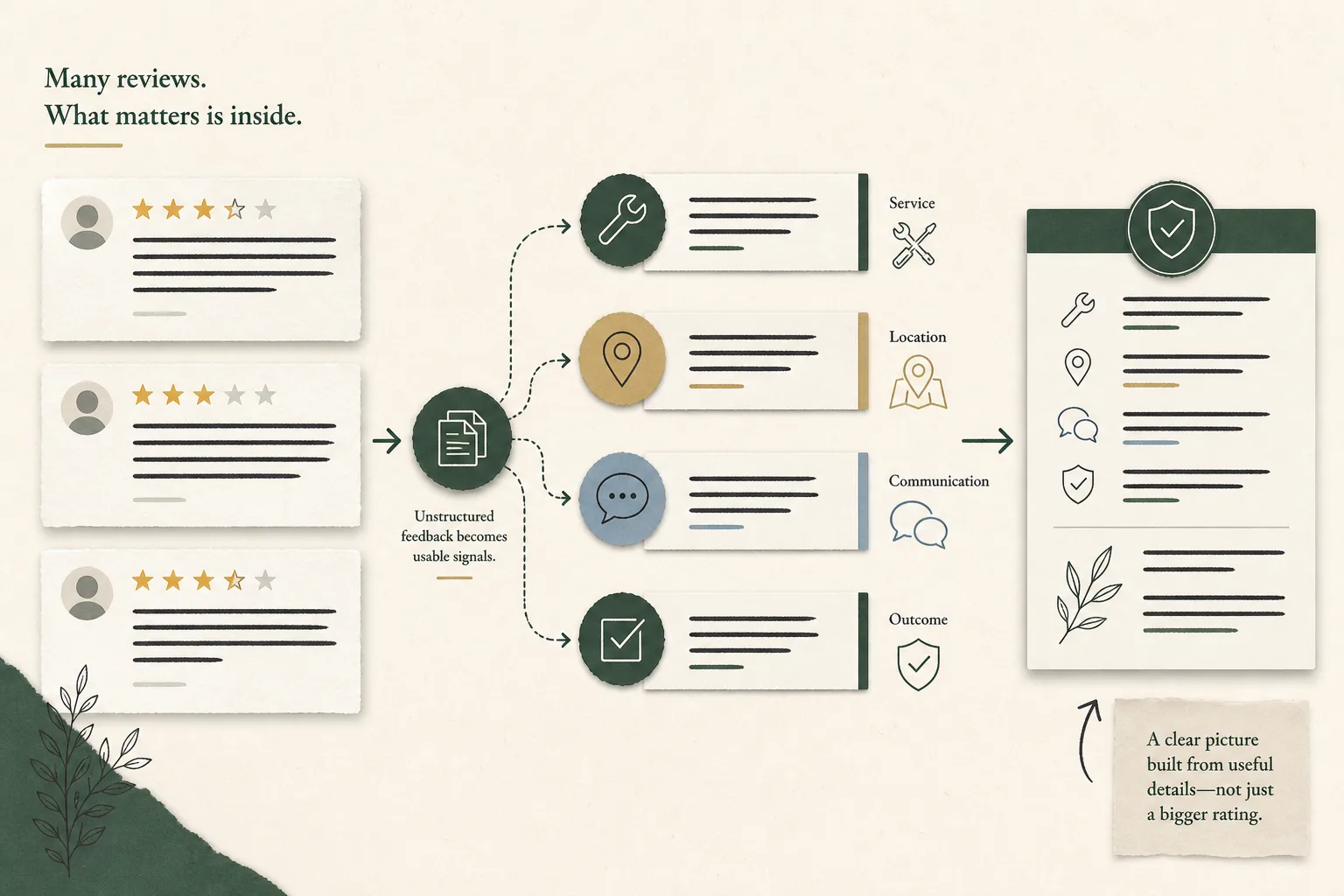
Reviews are often treated as a number: an average rating and a total count. Those numbers are useful, but they are only the front cover. The words customers use can show what the business is actually trusted for.
That detail helps future customers understand the experience and gives search engines and AI clearer evidence to connect with services, locations and buying questions.
Specific reviews carry more useful information
“Great service” is positive but broad. A review that mentions the job, location, communication, timing and result gives a much clearer picture.
For example, a customer may mention that a plumber explained the repair before starting, arrived when promised and left the site tidy. Those details support reliability and communication in a way a slogan cannot.
Look for patterns, not one perfect sentence
One review is a customer account. A repeated pattern across independent reviews is more meaningful. If customers consistently mention clear advice, specialist knowledge, careful workmanship or easy booking, that language can help define the strengths your website should explain.
Use the pattern to guide your own copy, while keeping reviews attributed and accurate. The website can explain the service; the reviews provide supporting customer evidence.
Connect reviews to the page where they matter
A large review carousel on the home page is easy to miss. A relevant review beside a service, location or proof story gives the reader useful context at the point of decision.
- Place service-specific reviews on the matching service page.
- Use branch or suburb reviews on genuine location pages.
- Connect outcome-focused reviews to a case story or project example.
- Keep a broader selection on a dedicated proof page for visitors who want more detail.
Make the source and context clear
State where a review came from and avoid changing its meaning. Use the customer name only when you have permission and follow the source platform's terms. Dates can be useful where freshness matters, especially for changing services, branches or team members.
If a review was supplied directly rather than posted publicly, say so. Plain attribution builds more trust than polished ambiguity.
A thoughtful response adds useful context
A thoughtful response shows that the business listens and understands the work being discussed. Keep it brief, human and relevant. Avoid repeating private details or turning every response into an advertisement.
Critical reviews also deserve a calm response. Future customers often pay attention to how a business handles a problem, not only whether every review is perfect.
Use reviews to find content gaps
Reviews can reveal the questions and benefits your current pages fail to explain. If customers repeatedly praise a process, product range, service area or team behaviour that is barely mentioned on the website, that is a useful content clue.
A practical review checklist
- Ask at a natural point after the work or purchase is complete.
- Make the review link easy to find and use.
- Invite honest detail rather than prescribing flattering words.
- Check for recurring service, location and experience themes.
- Place selected reviews beside the claims they support.
- Keep attribution accurate and permissions clear.
Reviews work best as connected evidence. They help customers see what working with the business is like and give AI more specific public information about why the business may be a credible option.